

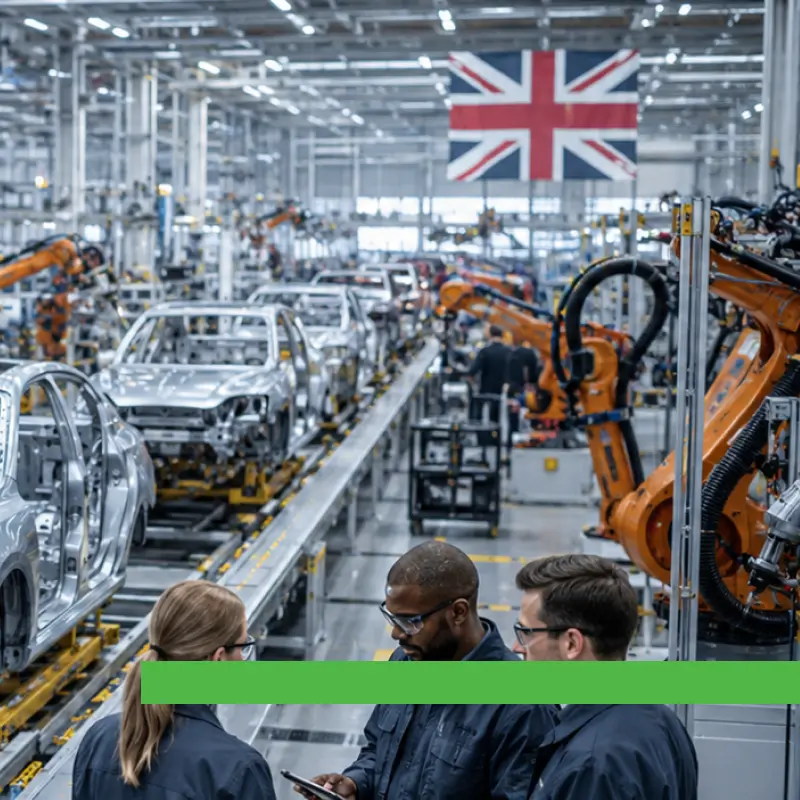
A good example of this is the current situation of the UK automotive industry. According to SMMT data, UK vehicle production increased by 2.7% in May 2026 compared with the same period of the previous year, reaching a total of 51,178 vehicles. Passenger car production also increased, while commercial vehicle output declined. This contrast clearly shows that automotive production is not developing evenly, but that different segments are facing different challenges and opportunities.
The situation of the UK automotive industry is important not only locally, but also for Europe as a whole. The European automotive industry operates as a closely connected system, in which manufacturers, suppliers, logistics partners and industrial service providers work together across several countries. Changes in a major automotive market can affect supplier capacities, parts supply, export processes, investment decisions and production support needs.
The latest figures show that production is capable of growing, but long-term stability should not be taken for granted. Manufacturers are facing high industrial costs, labour market challenges, regulatory expectations, export market uncertainty and the investment demands of the electric transition at the same time. Today, automotive companies do not only need to produce vehicles; they also need to continuously adapt to a rapidly changing market and technology environment.
According to SMMT, the increase in May was supported partly by stronger exports, particularly to the United States. At the same time, exports to other key markets, including the European Union and China, declined. This shows how strongly automotive manufacturing now depends on the international trade environment, tariffs, regulations, supply chain stability and changing consumer demand.
One of the biggest questions for manufacturers is how they can remain competitive while investing significant resources in new technologies, zero-emission vehicles, electric powertrains, production line upgrades and workforce development. The production of electric and hybrid vehicles requires a different technological background, different component supply and different quality control processes than traditional powertrains. This affects not only car manufacturers, but the entire supply chain.
In this environment, the role of the supply chain is becoming increasingly important. In an automotive manufacturing process, every delay, capacity issue or quality problem can have an impact on the entire system. This is why partners that can respond to changing needs in a stable, accurate and flexible way are becoming more valuable. Quality assurance, production support, inspection processes, workforce organisation and fast adaptability are all areas that gain particular importance in a more uncertain market environment.
The UK automotive industry also shows that changes in production volume are not always predictable. One month may bring growth, while the next may bring a decline, and companies still need to meet deadlines, quality expectations and customer requirements continuously. This creates an operating environment where flexibility is no longer just an advantage, but a basic requirement for competitiveness.
The electric transition is also having a major impact on automotive production. The development of zero-emission technologies is essential in the long term, but in the short term it may place significant financial and operational pressure on manufacturers and suppliers. The introduction of new technologies does not only mean new vehicle models. It also means new manufacturing processes, new supplier requirements, new training needs and new quality management considerations.
Based on current automotive trends, it is becoming increasingly clear that the most successful companies will be those that can operate efficiently, flexibly and at a consistently high quality level. Cost efficiency, a stable supplier background, fast responsiveness and continuous improvement are all factors that may define the competitiveness of manufacturing companies in the years ahead.
The growth in UK vehicle production in May is therefore an encouraging sign, but it does not mean that the automotive industry is no longer under pressure. Manufacturers are still dealing with costs, regulatory requirements, export market uncertainty and the challenges of the electric transition at the same time. This situation also carries an important message for Europe: the future of the automotive industry depends not only on new models and technologies, but also on how reliably, flexibly and efficiently the entire manufacturing and supplier background can operate.
Companies that can remain stable partners in this changing environment will not only follow the transformation of the automotive industry, but may also become active participants in its next era.
Source:
SMMT – Vehicle production up but pressures persist
https://www.smmt.co.uk/
Additional source:
The Wall Street Journal – U.K. Auto Manufacturing Rose Slightly in May
https://www.wsj.com/business/autos/u-k-auto-manufacturing-rose-slightly-in-may-8c0f009f